


Category: HAST Testing

  • What is HAST Testing?

    What is HAST Testing?

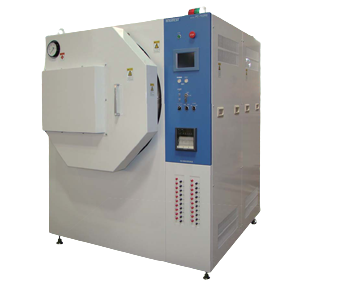
    Understanding what is HAST testing is essential for engineers qualifying semiconductors, electronic packages, and advanced materials for long-term reliability. HAST (Highly Accelerated Stress Testing) uses elevated temperature and humidity under pressure to accelerate moisture-driven failure mechanisms in a fraction of the time required by conventional THB testing.

    What Is HAST Testing? A Complete Overview
    What is HAST Testing?

    In effort to improve the reliability of products, many different industries, just to mention a few, including semiconductor, pharmaceutical, LED and solar companies turn to HAST testing as a shorter alternative to THB Testing.

    The acronym “HAST” stands for “Highly Accelerated Temperature/Humidity Stress Test.” The acronym “THB” stands for “Temperature Humidity Bias.” THB testing takes 1000 hours to complete, whereas HAST Testing results are available within 96-100 hours. In some cases, results are available in even less than 96 hours. Due to the time saving advantage, the popularity of HAST has continuously increased in recent years. Many companies have completely replaced THB Test Chambers with HAST Chambers.

    THB (Temperature/Humidity/Bias) holds 85°C/85% RH condition while bias loads are applied to the samples. It has become less useful in recent years due to the improved packaging and passivation materials.

    Highly Accelerated Stress Test (HAST) was formulated to decrease the test time needed to get useful results. Due to time constraints on projects, engineers look for a faster solution to learn if their product meets the standards of their particular industry. HAST testing uses a high temperature (105°C), high relative humidity (about 85%), and high atmospheric pressure conditions (up to 4 atm). HAST testing loads the specimen with heat and moisture stresses to find the concealed defects that could cause failure for the user relying on it. In testing products for reliability, defining the test conditions is the primary step. A common standard used for HAST is JEDEC JESD22-A110. Test conditions must meet application conditions in order to make testing relevant. HAST Testing has also in turn become a more cost effective alternative.

    HAST is recommended for the shortened qualification of any change that can potentially affect the corrosion resistance of the product. Therefore, a new package and/or a new fab assembly site demands HAST data. HAST is also recommended for changes in the die glassivation, metallization or thin film resistors, as well as changes in the molding compound.

    HAST Testing continues to find more applications for accelerated testing of newer materials and products.

    For more information, see our guide on how to select a HAST chamber.

  • How to Select a HAST Chamber

    How to Select a HAST Chamber

    Knowing how to select a HAST chamber correctly can mean the difference between a reliable long-lived investment and years of maintenance headaches. This guide covers the critical selection criteria: test volume, pressure rating, temperature accuracy, controller quality, patent position, parts availability, and after-sales support.

    How to Select a HAST Chamber: Key Criteria for Buyers

    How to Select a HAST Chamber

    HAST (Highly Accelerated Stress Test) Articles:

    Part I

    HAST CHAMBERS

    When you are looking for a HAST Chamber keep two key aspects in mind:

        1. 1. A HAST CHAMBER is a Precision Scientific Instrument – It is NOT a run-of-the-mill Temperature and Humidity Chamber. It is a piece of testing equipment required to perform Highly Accelerated Stress Test under very precise set conditions of Temperature & Humidity under Pressure.
        2. 2. NOT ALL HAST CHAMBERS ARE CREATED EQUAL

    Anyone looking for a HAST CHAMBER should keep these two key points in mind. If not, they will face the same problems as those who did not consider the above are facing today.

    Every HAST CHAMBER manufacturers’ specifications appear to meet JEDEC and the JIS standards but in practice may not. Unfortunately, most test engineers do not discover these short comings until it’s too late. Understandably, no one wants to admit a big mistake in the purchase of a fairly expensive piece of capital equipment so the inaccurate testing just continues, undercover.

    A truly objective and informed HAST Chamber Manufacturer MUST:

        1. Guarantee the results and performance of a HAST Chamber over long periods of testing and time. Means: Non-Condensing Atmosphere & absolutely No Rain….These two factors are enough to create Leakage paths leading to erroneous failure conditions.
        2. Explain why moving air with a fan in a HAST environment is an unnecessary complication and can be detrimental to the test. Fans create hot spots and inconsistent atmospheric conditions. These air circulating units also require continuous costly replacements.
        3. Guarantee that the Chamber will not leak water onto the lab floor.
        4. Make clear if superior dual-chamber technology, a proven method for over forty years, is offered in the design of the HAST CHAMBER.
        5. Inform if certain costly key parts/components in the HAST CHAMBER must be replaced frequently and why.
        6. Admit that a larger chamber may be less accurate than the standard size.
        7. Clarify why or why not the wet-bulb, dry-bulb is required in a HAST CHAMBER. Inform the customer if frequent service calls are required to maintain it’s HAST CHAMBER.
        8. Inform the customer that ONLY one company in the world has the patents and rights on this UNIQUE DUAL CHAMBER technology for a HAST CHAMBER.
        9. Enlighten the customer that there is only ONE company in the world that will provide long term parts and labor warranty for a HAST CHAMBER at almost no cost or very minimal costs to them.
        10. Notify the customer that there is ONLY one company in the world that has its previous five generations of HAST CHAMBERS still in operation through out the world – A span of OVER THREE DECADES.

    Just because a manufacturer makes good Temperature and Humidity Chambers, is not a justification that the same manufacturer can make good precise HAST CHAMBERS. Same goes for aesthetics. A pretty paint job does not necessarily mean better technical and or improved performance. Not by a long shot. One cannot compare apples to oranges.

    Part II

    Why is it that there are hundreds of manufacturers making Temperature and Humidity and other Test Chambers today, but there are only a handful of them making the HAST CHAMBERS, even though this technology is over forty years old? The answer is that this system is too precise and is protected by several international patents to be made by just anyone. It has to be made by the specialists in this unique field.

    Here again the Rule number from two Part I applies.

    “NOT ALL HAST CHAMBERS ARE CREATED EQUAL”

    Consider the high profile list of satisfied customers who have been enjoying the benefits of the HIRAYAMA HAST CHAMBER for over three decades. Contact any Hirayama customer and you will find few to none willing to part with their Hirayamas’, regardless of whether the chamber is 20 days old or 20 years old. It is extremely difficult to find a used Hirayama for sale.

    Just because a manufacturer makes good Temperature and Humidity Chambers, is not a justification that the same manufacturer can make good precise HAST CHAMBERS. Same goes for aesthetics. A pretty paint job does not necessarily mean better technical and or improved performance. Not by a long shot. One cannot compare apples to oranges.

    Furthermore, almost every major Commercial Test Lab in the Bay Area and around the world that does HAST TESTING uses Hirayama HAST Chambers. Commercial Test Labs demand the best because they are dealing with demanding customers, who prefer to blame the test equipment when a failure occurs rather than their test specimen/s under test. No lab can afford to take that chance by using inferior chambers. Those who have done so can say good bye to their HAST business.

    When you purchase a Hirayama HAST CHAMBER, you get a Quality HAST system made to the highest standards of manufacturing and engineering excellence. This HAST system will perform year after year and will meet specifications year after year with a low to no maintenance required.

    Part III

    Benefits of the HIRAYAMA HAST Chambers-

    The Green System from Hastest Solutions

      1. Non-Condensing atmosphere
      2. No Rain
      3. Fully self contained – No special facilities or plumbing required
      4. Plug & Play – Connect AC Power, Connect the Drain and you are ready to go
      5. Occupies only 9 sq ft of footprint
      6. Abundant Safety Features
      7. Dual Chamber technology
      8. Virtually maintenance-free
      9. No Reach-in requirement – Specimens come out in a tray
      10. Chamber never gets hot
      11. Without FANS – A uniform non-condensing atmosphere
      12. Self-Cleaning Features
      13. On-Screen Self Diagnostics
      14. Problem identification and suggested solutions-On Screen
      15. Does not require operator computer training-Simple instructions
      16. GREEN MACHINE:
        1. Low Power Consumption
        2. No Wastage
        3. Does NOT produce any Waste By-Products
      17. Unique Door Locking mechanism
      18. Self-locking door with built in safety features
      19. Drain could be a simple bucket
      20. Exceeds all levels of manufacturing & workmanship standards
      21. Every connection, every wire identified throughout the system
      22. Electronic system totally isolated from the main chamber and plumbing
      23. Stainless steel plumbing circulates all incoming water
      24. Non corrosive atmosphere

    For more information, see our guide on what is HAST testing and why chamber selection matters.

  • Reliability Tests of Ultrasonic Bonding Methods Using HAST and THB

    Reliability Tests of Ultrasonic Bonding Methods Using HAST and THB

    This technical study examines ultrasonic bonding HAST testing as a method for evaluating the long-term reliability of wire bonds and die-attach interfaces under accelerated moisture stress. Both HAST and THB methods are applied to ultrasonic bond specimens to identify failure modes at the package and board interconnect level.

    Ultrasonic Bonding HAST Testing: Test Methodology and Findings

    Reliability Tests of Ultrasonic Bonding Methods Using HAST and THB

      HAST (Highly Accelerated Stress Test) Articles:

      Reliability Tests of Ultrasonic Bonding Methods Using HAST and THB

      Reliability is one of the most important questions in any application, on both the package (component) and the board (system) levels. The paper describes some life time test methods, equipment and processes for evaluating the most important reliability parameters. It gives a detailed description of the most effective and economical HAST (highly accelerated stress test) and THB (temperature humidity and bias) methods.

      The paper presents some new results of using HAST and THB technology for the following fields of reliability and life time tests: reliability analysis of assembled SMD passive components; water addition speed tests. Finally, the paper particularly deals with ultrasonic bonding technology, the bonding and testing machines. It introduces some measurement test results on the bonding force before and after a HAST and THB test.

      This paper appears in: Electronics Technology: Meeting the Challenges of Electronics Technology Progress, 2004. 27th International Spring Seminar

    For more information, see our guide on HAST testing fundamentals and JEDEC standards.

  • A Comparison of HAST to Conventional THB Testing

    A Comparison of HAST to Conventional THB Testing

    The comparison of HAST vs THB testing is a critical decision for reliability engineers qualifying plastic-encapsulated components and other moisture-sensitive devices. HAST uses pressurized conditions above the dew point to dramatically reduce test time from 1,000 hours to fewer than 100 hours compared to conventional THB.

    HAST vs THB Testing: Head-to-Head Technical Comparison

    A Comparison of HAST to Conventional THB Testing

      HAST (Highly Accelerated Stress Test) Articles:

      A Comparison of HAST to Conventional THB Testing

      The use of HAST (highly accelerated stress test) for reliability assessment of nonhermetic packages is driven by reliability improvements in plastic packaging and passivation materials. Conventional Temperature/Humidity/Bias (85/85) testing is inefficient in measuring these reliability performance improvements. HAST is a highly effective and repeatable assessment tool for evaluating plastic package reliability provided appropriate controls are used. Important HAST to conventional 85/85 testing on 16Kx4 commodity SRAM’s. Data from multiple HAST runs on different lots of the same SRAM test vehicle shows the repeatability of the stress test. Data from the same SRAM part type stressed in 85/85 shows lower comparative accelerations for the same failure mechanisms. Surprisingly, metal-corrosion is not the dominant failure mechanism in these tests. Systematic AC parameter shifts are the predominant cause for failure. A relative acceleration factor for HAST over 85/85 testing is extracted based on AC parameter shifts in plastic-packaged parts succumbing to a moisture-driven failure mechanism. This data provides another example of HAST capability and an indication of the type of failure mechanisms that can be found with today’s plastic packaging materials.

      This paper appears in: Electronic Components and Technology Conference, 1994. Proceedings, 44thAbstract Plus

    For more information, see our guide on complete guide to HAST testing methodology.

  • Hirayama HAST Chambers for Solar Cells and Photovoltaics

    Hirayama HAST Chambers for Solar Cells and Photovoltaics

    HAST testing solar cells and photovoltaic modules is an emerging application of Highly Accelerated Stress Testing that allows PV manufacturers to qualify new cell technologies under accelerated moisture and thermal stress. Hirayama HAST chambers distributed by Hastest Solutions in North America provide the precise pressure, temperature, and humidity control required for PV module qualification.

    HAST Testing Solar Cells and Photovoltaic Modules

    Hirayama HAST Chambers for Solar Cells and Photovoltaics


      • 20 Sep 2007

    News Release, San Jose, CA


    Don’t Just Test it -…………HAST it
    ……And when your testing time is critical,
    Accelerate it……speed it up by a factor of 10.

    Almost every product needs to be tested for long term viability and the time-to-market invariably is always short – so what do you do? You accelerate the test.

    And how do you accelerate this test? By utilizing the internationally acclaimed Highly Accelerated Stress Test Chamber, also known as HAST Chamber made by HIRAYAMA.

    HAST has been an integral part of most all testing of Materials; be it Semiconductors, Solar Cells, Photovoltaics, Ceramic, Glass, Rubber, Paper, Polymer, Wood, Laminates, LCD’s, Etc. for the past 50 years or so.

    And HAST is a vital part of the Reliability Test program under which the temperature and humidity parameters are exercised. In standard environmental testing, the resistance to humidity conditions are generally tested much below 100 °C while HAST or PCT [Pressure Cooker test] is performed at Temperatures of over 110 °C together with a very high density of water vapor leading to Humidity test conditions of over 65 % RH.

    The HAST/PCT Chamber creates an atmosphere inside the chamber whereby the difference in water vapor conditions [Pressurized HOT Steam] inside the test materials and outside of the test materials are very high. This condition is used to check the resistance to humidity conditions of the test material under high temperatures.

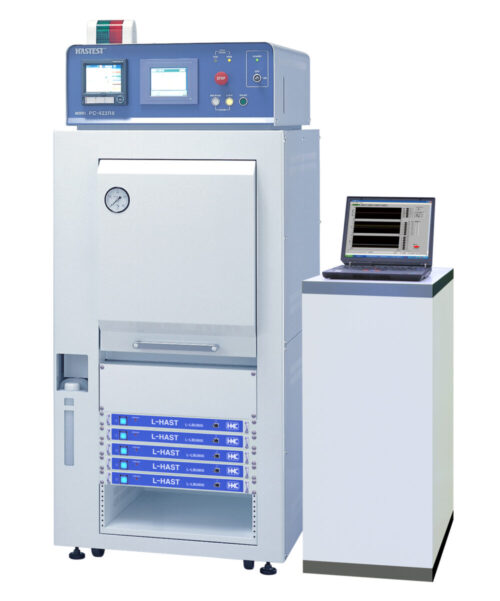
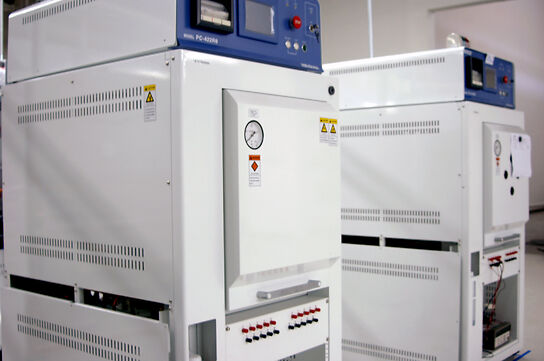
    When you need to test the long-term survivability of a product, or simply need to get to market faster, accelerated testing methodology using the HAST/PCT chamber is the obvious answer. It is a crucial part of a complete reliability testing program, via the accelerated testing technology using HIRAYAMA HAST Chamber, the latest Model PC-422R8.

    Please go to www.hastest.com for a more detailed analysis/description/specifications of these extremely powerful systems for testing Solar Cells, Photovoltaics, Ceramics, Glass, Polymers, Wood, and almost any Material using the HAST Chamber.

    Hastest Solutions is the leader in providing Environmental Test Chamber Technology and Solutions to a number of industries which include materials such as: Solar, Ceramics, Glass, Paper & Pulp, Rubber, Semiconductors, Laminates, Polymer, Wood, etc.

    For more information, see our guide on Hirayama HAST chambers available from Hastest Solutions.